A defense contractor was sharing a sensitive document on ChatGPT during a screen share.
Not maliciously. They just wanted a faster way to work. They did not think of it as a data breach. They thought of it as using a tool.
This is happening in your organization right now. Research from 2025 found that at companies with 5,000 or more employees, over 60% of employees are using unapproved AI tools weekly, and roughly a third of them regularly input customer or proprietary information into those tools.
Nobody told the AI governance team. Nobody asked for permission. And depending on your industry, some of it is already a compliance issue.
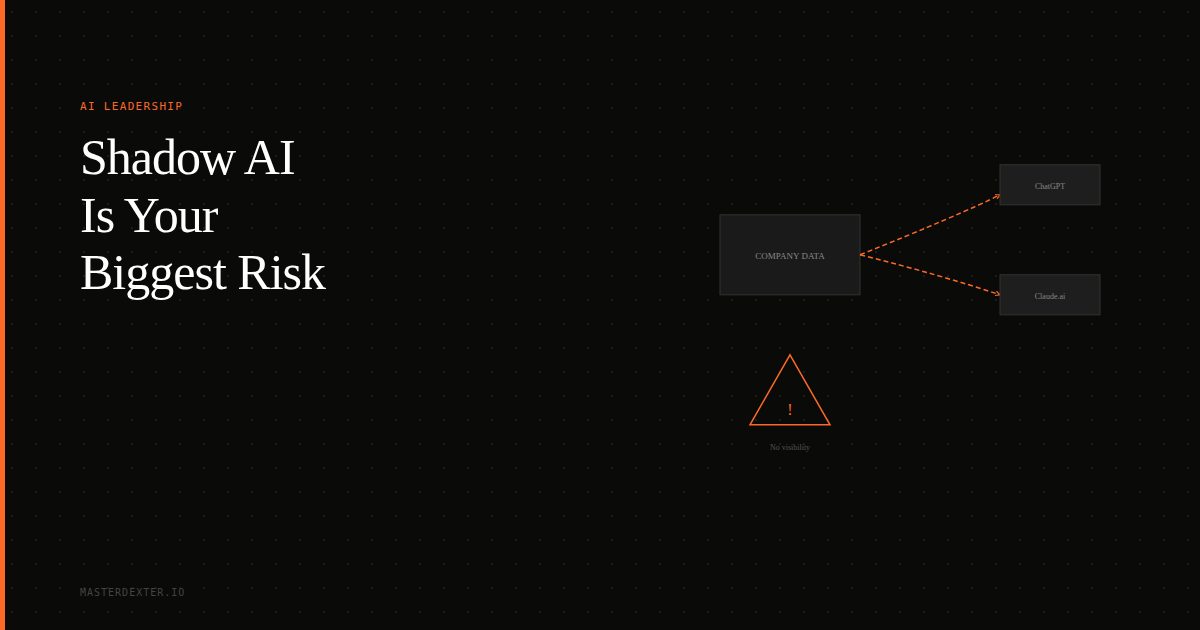
This is Shadow AI. And it is almost certainly your company's most active, least managed AI risk.
What shadow AI actually is
Shadow AI refers to any AI tool, model, or agent being used by employees for work-related purposes that has not been registered in a central inventory and reviewed under your governance process.
The Shadow AI problem has three layers:
The visible layer: Consumer tools the employees acknowledge using. ChatGPT, Claude.ai, Gemini, Copilot. Most employees will admit to these if asked directly. The exposure is real but at least discoverable.
The embedded layer: AI features inside tools you already pay for. Salesforce Einstein, HubSpot AI, Notion AI, Microsoft 365 Copilot. These often turn on by default with a software update. Most IT teams do not track which AI features are active in which tools.
The invisible layer: Personal API access, browser extensions, custom scripts, and small internal tools that individual engineers built. These are the hardest to find and often process the most sensitive data because they were built specifically to solve a production problem.
Why this is a legal problem, not just a security problem
When an employee uploads a document to ChatGPT or Claude.ai:
- The document text is sent to the provider's servers
- It is stored in their systems, temporarily or permanently depending on settings
- It may be used to improve their models
- The company that owns that document has no visibility, no control, no deletion capability
For a law firm, that document might contain privileged client communications. For a hospital, it might contain protected health information. For a financial services firm, it might contain material non-public information.
HIPAA violations cost $100 to $50,000 per incident. GDPR fines can reach 4% of global revenue. India's DPDP Act fines go up to 250 crore rupees per violation. And beyond the direct fines: enterprise contracts increasingly include audit rights for AI systems and termination clauses if you fail a compliance audit.
The employee did not intend harm. They just wanted a useful tool. But the action created legal exposure that accumulates silently until it does not.
The shadow AI audit: how to find what you have
Run this before you build any governance process around it. A governance process that governs 60% of your AI usage is not a governance process.
Step 1: The anonymous survey (3 questions)
Send to all employees. Anonymous. No punishment framing.
- Which AI tools do you use at work, with or without company approval?
- What kind of data do you put into them?
- What would make you switch to a company-approved tool instead?
The results will surprise you. The most valuable insight is usually not the tool names but the data types: "I paste customer emails to get draft replies" or "I upload our internal pricing spreadsheets to ask questions" are the answers that tell you where your exposure is.
Step 2: The amnesty window (30 days)
Announce a 30-day period during which employees can surface currently used unapproved tools without penalty. Just disclose.
This does two things: it gives you a real picture of your AI footprint, and it builds trust that governance is about protection rather than punishment. The teams who experience the amnesty process as collaborative are far more likely to follow the governance process going forward.
Step 3: IT audit of network traffic
Work with your security team to review DNS queries and outbound traffic for known AI service domains (api.openai.com, api.anthropic.com, generativelanguage.googleapis.com, and others). This does not tell you what data was sent, but it tells you the volume and frequency, which tells you which departments are most active.
Step 4: Software inventory review
Review your SaaS subscriptions and the AI features that are enabled or available in each. Salesforce, HubSpot, Zendesk, Notion, Microsoft 365, and most major SaaS platforms now have AI features that may be active without explicit IT approval.
The response: approved tools and fast intake
The goal after the audit is not to ban AI. That will fail. Employees will continue using it anyway and become less likely to be transparent about it.
The goal is to replace shadow usage with approved alternatives that give employees the capability they want with the data controls you need.
The approved tool list:
Publish a list of AI tools that IT and Legal have reviewed and approved, along with which data tiers are permitted with each tool. Update it quarterly. Make it easy to find.
Format example:
| Tool | Approved for | Not approved for |
|---|---|---|
| Claude Enterprise | Internal docs, drafts, code | Customer PII, financial data |
| GitHub Copilot | Code generation | Code containing secrets |
| Notion AI | Internal notes | Client-facing materials |
The fast intake process:
When an employee wants to use a tool not on the list, they should be able to submit a request and get an answer in 5 business days, not 6 weeks. If the approval process is too slow, employees route around it. A fast intake process is what turns the approved tool list from a rule into a service.
The specific risks by data type
Not all shadow AI exposure is equal. These are the highest-risk patterns:
Customer PII into consumer AI tools. Any tool that processes customer names, emails, addresses, or account numbers without a Data Processing Agreement violates GDPR and most similar regulations. This is the most common high-severity exposure.
Confidential business strategy into public AI. Pricing strategies, M&A information, competitive analysis, and unreleased product plans sent to consumer AI tools are available to the model provider and potentially used in model training.
Source code into unvetted tools. Code containing API keys, authentication tokens, or proprietary algorithms sent to AI coding tools can expose security credentials or intellectual property.
Medical or financial information. HIPAA and financial regulations require specific Business Associate Agreements and data handling standards. Consumer AI tools do not provide these. Any exposure in these categories creates immediate legal risk.
What good shadow AI management looks like
Six months after running a thorough shadow AI audit and implementing fast intake:
- You have a real picture of AI usage across the organization
- The approved tool list covers 80%+ of what employees actually want to use
- Unapproved tool usage for sensitive data has dropped significantly (not to zero, but to a manageable, monitored level)
- New tool requests are processed in under a week
- The security team reviews new AI tools with a standard questionnaire rather than ad-hoc evaluation
You will not eliminate shadow AI entirely. The goal is to understand it, minimize high-risk usage, and create an organizational culture where employees bring AI questions to the governance process rather than hiding them.
The companies that handle this well make the approved process easier than the shadow process. That is the entire strategy.
Building AI governance that employees actually follow?
In The Elite AI Leadership Accelerator, we cover shadow AI audits, approved tool frameworks, and the governance design that makes compliance a default rather than an obstacle. This is practical work, not theory.
What I build and how I can help
- MasterDexter live cohorts
- MasterDexter Teams - private cohorts to train your AI team on production systems
- AITalentStudio - vetted, production-ready AI talent for your company
- Dextar - AI engineering development and consulting for enterprises and startups
- Buildership - ideas to ship real AI