Your competitor just lost a $20 million enterprise deal.
Not because their AI was worse. Their legal team could not produce an EU AI Act conformity assessment. The buyer's counsel asked for it. They had nothing. Deal dead.
This is happening every week now. The EU AI Act entered full enforcement in February 2026. The European AI Office is staffed. It has enforcement authority. Enterprise procurement teams have added AI compliance questions to standard RFPs.
The companies that built compliance into their architecture from day one are closing deals faster, not slower. Compliance stopped being a legal tax and became a sales weapon.
Here is what you actually need to do.
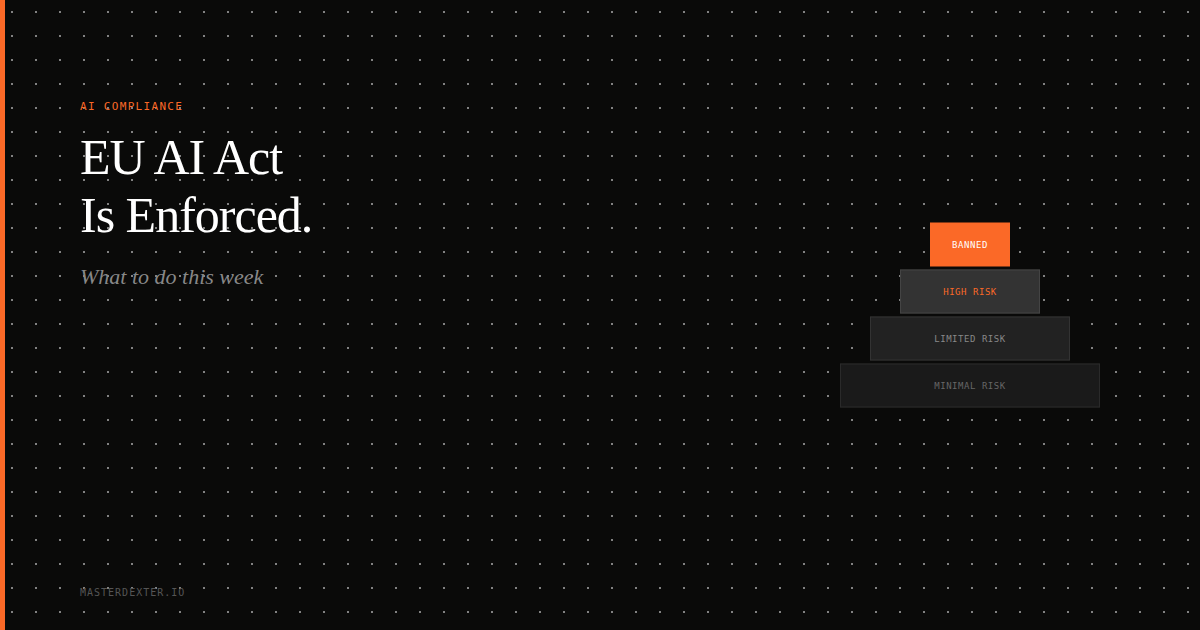
First: know your risk tier
Before anything else, classify your AI systems. The tier determines everything: what documentation you need, what testing is required, and what happens if you do not comply.
The decision tree is straightforward:
Does the AI make or influence decisions about people?
Yes. Does it affect employment, credit, health, education, or safety?
- Yes: HIGH RISK. Conformity assessment required before deployment.
- No: Does it interact with users directly?
- Yes: LIMITED RISK. Transparency requirements apply.
- No: MINIMAL RISK. No specific obligations.
No: MINIMAL RISK.
If you operate in multiple verticals, score each use case separately. A single AI platform can be low-risk in one deployment and high-risk in another based entirely on context.
High-risk categories that commonly apply to enterprise AI:
- AI used in employment decisions (hiring, performance management, termination)
- AI used in credit or insurance assessments affecting individuals
- AI used in educational assessment
- AI that processes biometric data for identification
- AI managing critical infrastructure
If your AI system touches any of these and serves EU users or employees, you are in the high-risk category regardless of company size.
What "high risk" actually requires you to build
Most compliance guides give you the abstract version. Here is what your engineering and legal teams need to actually produce:
Technical documentation package. A technical file must exist before the system goes live. Not a slide deck. A file that can survive regulatory scrutiny. It must include a system purpose statement, architecture diagram with data flows, training data provenance records, bias testing results with methodology, human oversight mechanism description, incident response procedure, and version history log.
Human oversight mechanisms (Article 14). High-risk systems must be designed so that humans can understand what the system is doing, intervene when needed, and override outputs. This means a dashboard or interface where a qualified person can monitor outputs in real time, a clear override mechanism, an audit log showing what the AI decided and when, and a process for escalating anomalies. "We have a human review option" in a footnote does not satisfy this. You need a designed, documented workflow.
Post-market monitoring (Article 72). Once you deploy, you are not done. High-risk systems must have a post-market monitoring plan that systematically collects and analyzes performance data. Ongoing. Until you decommission the system. This means logging AI decisions, sampling outputs for quality review, tracking user-reported errors, and updating your technical file when the system changes.
The US state law you are probably also missing
There is no federal AI law. What you have instead is a growing patchwork of state requirements that are increasingly enforced.
Colorado AI Act (effective February 1, 2026): Applies to "high-risk AI systems" used by Colorado consumers, covering employment, education, financial services, housing, healthcare, and insurance. Requirements: disclose to consumers when AI is used in a consequential decision, conduct impact assessments before deployment and annually after, provide a process for consumers to appeal AI decisions, and maintain records of impact assessments for 3 years. Fines: up to $20,000 per violation.
California SB 53: Targets developers of large foundation models trained above a compute threshold. Requires safety incident reporting procedures and notification to the California Department of Technology within 72 hours of a significant safety incident.
The practical formula:
Compliance Score =
  (Tier 1 States Covered / Tier 1 States Operating In)
  x (Tier 2 States Covered / Tier 2 States Operating In)

Tier 1: EU, California, Colorado, Illinois (high enforcement, high fines)
Tier 2: Utah, Texas, Tennessee, Montana (active but lighter enforcement)

Target score: 1.0 for Tier 1, 0.8+ for Tier 2
If you are below 0.8 on Tier 1 and operating in those markets, stop and fix it. The business interruption risk from a cease-and-desist is greater than the compliance cost.
The deal math that makes this a revenue decision, not a cost decision
Enterprise procurement cycles have a security and compliance review phase that typically takes 4 to 8 weeks. Companies with mature AI compliance programs are cutting that to 1 to 2 weeks by pre-answering every question.
On one deal:
- Average enterprise SaaS contract: $500,000 ARR
- Average compliance review delay: 6 weeks
- Annual carrying cost of a 6-week delay (capital tied up, sales rep time, opportunity cost): $60,000+
- Cost to build a compliance documentation package that eliminates that delay: $80,000 one time
Payback period: less than two deals.
A Series B FinTech in credit decisioning made this bet in early 2025: hired a compliance architect at the same time as their first ML engineer. Cost over 12 months: approximately $180,000 in engineering time and legal fees.
They became one of the first FinTech AI companies in Europe to receive regulatory clearance from BaFin. Three competitors lost deals to them in Q4 2025 because they could not show equivalent documentation.
Revenue attributable to that compliance investment in year one: estimated $2.4 million in contracts that cited regulatory clearance as a decision factor. ROI: 13.3x in year one.
The 90-day sprint to a defensible compliance posture
You do not need a year to get to a defensible posture. Here is a realistic 90-day plan:
Days 1 to 30: Inventory and score
Run the AI Risk Assessment Formula on every production AI system:
AI Risk Score (ARS) =
  (Impact Level x 0.4)
  + (Data Sensitivity x 0.3)
  + (Autonomy Level x 0.2)
  + (Regulatory Exposure x 0.1)

Score 1.0 to 2.0: Minimal Risk. Document and ship.
Score 2.1 to 3.0: Limited Risk. Basic documentation needed.
Score 3.1 to 4.0: High Risk. Conformity assessment required.
Score 4.1 to 5.0: Critical Risk. Board-level sign-off needed.
Get legal to review your vendor agreements for data processing terms. Check: does your enterprise agreement with your LLM provider include a data processing addendum? If not, you have a GDPR problem today.
Days 31 to 60: Document and build
Write technical documentation for your two highest-risk systems. Implement logging on all production AI systems. Build the audit trail. Map your human oversight workflows on paper before building anything technical.
Days 61 to 90: Test and verify
Run bias testing on your highest-risk system. Run a tabletop exercise simulating a regulatory audit. Fix the gaps the tabletop reveals. Engage an external compliance consultant for a half-day review.
At day 90, you should be ahead of 80% of your competitors. Compliance is not a state you reach. It is an ongoing practice. But day 90 gives you a defensible position.
The audit you are not ready for
Regulators and enterprise buyers audit in similar ways. Phase 1: documentation review. Phase 2: technical deep dive (they pull a sample of decisions and ask you to explain how the AI reached them). Phase 3: edge case testing (adversarial inputs, bias checks, demographic consistency).
If you cannot explain how your system reached a specific decision, you fail phase 2. Explainability is not a product feature. For regulated use cases, it is a legal requirement.
At minimum, your system needs to log what input triggered the decision, what data the model retrieved or referenced, what output was produced, and whether human review occurred.
If you cannot produce that log today, that is the first thing to build.
Need to build AI governance into your organization?
In The Elite AI Leadership Accelerator, we cover the full governance stack: AI Council design, risk tier classification, technical documentation frameworks, and the board communication that turns compliance into a competitive narrative rather than a cost center.
What I build and how I can help
- MasterDexter live cohorts
- MasterDexter Teams - private cohorts to train your AI team on production systems
- AITalentStudio - vetted, production-ready AI talent for your company
- Dextar - AI engineering development and consulting for enterprises and startups
- Buildership - ideas to ship real AI