Your data science team just presented to leadership.
Model accuracy improved from 89% to 94%. Inference latency is down. F1 scores look great.
Someone asked: "How much money did we make?"
Silence.
This happens constantly. Data scientists optimize for technical metrics because that is what they are trained to do. Product teams optimize for engagement because those numbers are easy to track. Finance looks at the budget burn and asks what they are getting for it. Everyone is measuring something different, so nobody knows if AI is actually working.
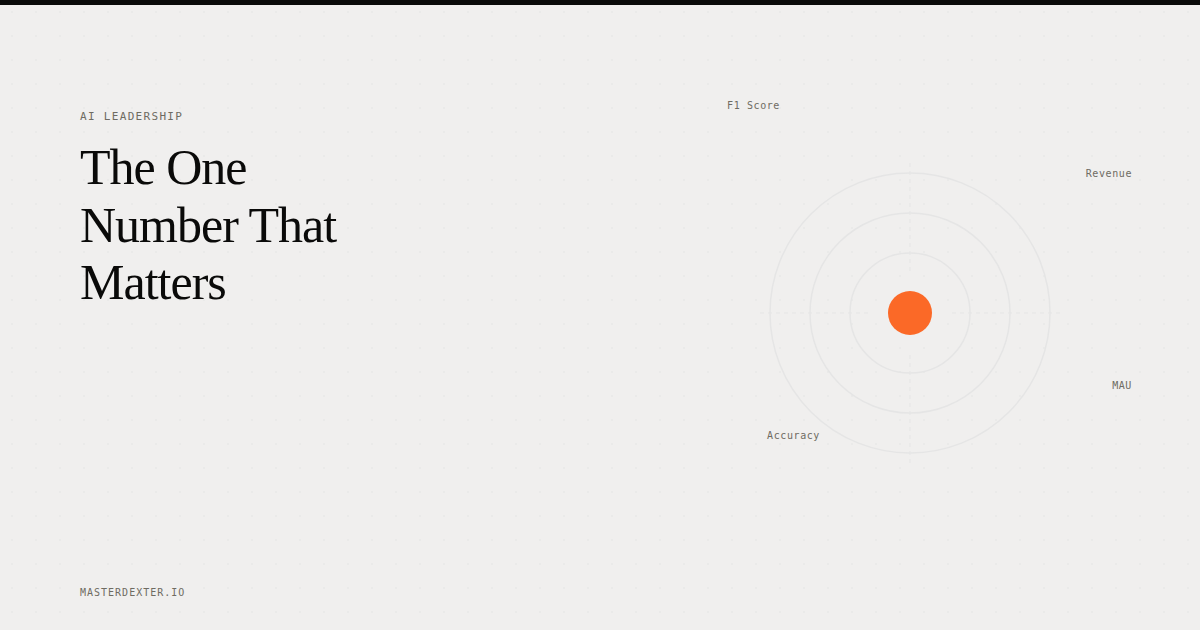
The North Star Metric is the fix. Here is how to define one that survives a board conversation.
Three rules that make a metric a North Star
It connects to revenue, directly or predictably.
"Model inference calls per day" is not a North Star. It just means the model is running.
"Support tickets resolved without human intervention" is a North Star. It saves money you can measure.
It reflects value your customer actually gets.
"95% sentiment analysis accuracy" is not a North Star. Customers do not pay for accuracy.
"Customer churn reduced by X%" is a North Star. Customers care whether their problems get solved, not how accurately you classified their complaint.
Everyone can influence it.
If only the data science team can move the number, it is a technical KPI. A real North Star ties product, engineering, sales, and support together. When everyone pulls in the same direction, the number moves.
Score any candidate metric on these three criteria, 1 to 3 each. Score of 9: strong North Star. Score of 6 to 8: supporting metric. Below 6: this is a technical KPI wearing a business suit.
The value test you should run before committing
Before locking in a metric, quantify whether it is worth pursuing at all:
Projected Annual Value ($) = Baseline Volume x Delta x Unit Value
Real example for support deflection:
500,000 tickets/year
x 40% deflection improvement
x $12 average cost per ticket
= $2.4M annual value
Then divide by your total AI cost for the year (team plus infrastructure plus tooling).
If the multiplier is under 2x, you are probably optimizing the wrong thing. The exercise forces the conversation most teams avoid: "What does a 10% improvement actually buy us?"
If no one can answer that in a room, you do not have a North Star yet.
A real case: three teams, one metric
This scenario plays out at most companies I work with.
A SaaS platform has three teams each proposing their AI metric as the company North Star.
Data Science proposes: F1 score on contract risk classification (improved from 0.71 to 0.89).
Product proposes: Monthly active users of the AI feature (grew 3.6x in six months).
Customer Success proposes: CSAT on AI-assisted support interactions (averaging 4.3 out of 5).
Which one should the CTO take to the board?
F1 score has zero direct link to revenue. Customers never see model precision. Only the data science team can move it. Score: 3 of 9. Technical KPI.
MAU has a predictable revenue link (more usage often means better retention) and all teams can influence it. But if MAU is growing because users try the feature once and leave, it masks a failing product. Score: 7 of 9. Supporting metric.
CSAT scores 8 of 9. Real customer outcome. All teams influence it. The revenue link exists but is not direct.
But here is the thing: none of these is actually the North Star.
The right North Star for that company was: "Percentage of Tier-1 support tickets resolved by AI triage with CSAT above 4.2 stars, tracked weekly against a $35,000/month run rate target."
It connects directly to cost and revenue. It proves the customer received real help, not just a response. Support, product, engineering, sales, and customer success can all influence it. And it fits in one sentence.
That last test matters. If your North Star takes a paragraph to explain, it is not a North Star yet.
How fast should it move?
Most leaders do not know what progress looks like week to week. In 2026, when boards are asking for quarterly ROI proof, this matters.
Cost reduction metrics: You should see movement in 30 to 60 days. If nothing is moving by 90 days, your deflection rate is probably false or your baseline was wrong.
Revenue generation metrics: Early signals show up in 60 to 90 days. Full validation takes a sales cycle, so 3 to 6 months minimum. Do not let your CFO kill a revenue-generation North Star because Q1 looks flat.
Strategic positioning metrics: 6 to 18 months. Worth tracking, but should not be your primary budget justification. Pair with a cost reduction metric if you need ROI proof now.
The reporting template that works
Every status update on your AI investment should follow this format:
North Star Metric: [Your metric]
- Current: [Number]
- Target: [Number]
- Change from last period: [+/- Number]
What moved it:
- [Top 3 initiatives that impacted the metric]
- [Actual impact measured]
What we are testing next:
- [Experiments planned]
- [Expected impact on North Star]
Blockers:
- [What is preventing faster progress]
- [What we need to accelerate]
One page. Everything ties back to the North Star. The board stops asking "is AI working?" and starts asking "what is blocking us from moving faster?"
The harsh truth
Most AI initiatives fail because teams never defined what success looks like in business terms.
Your North Star forces the connection. It makes AI a business investment, not a research project.
If your team cannot define a North Star metric, you do not have an AI strategy. You have a collection of experiments. And experiments are fine. But they do not justify $2 million budgets and 10 headcount.
Define your North Star. Make it specific. Make it measurable. Make it matter to the CFO.
Then build your AI to move it. Everything else is noise.
Building your AI strategy for the board?
In The Elite AI Leadership Accelerator, we work through North Star metric definition, ROI modeling, and board communication in the first two sessions. If you are a Head of AI, Director, or VP who needs to present your AI investment case, this is the program.
What I build and how I can help
- MasterDexter live cohorts
- MasterDexter Teams - private cohorts to train your AI team on production systems
- AITalentStudio - vetted, production-ready AI talent for your company
- Dextar - AI engineering development and consulting for enterprises and startups
- Buildership - ideas to ship real AI